
Cursive Practice
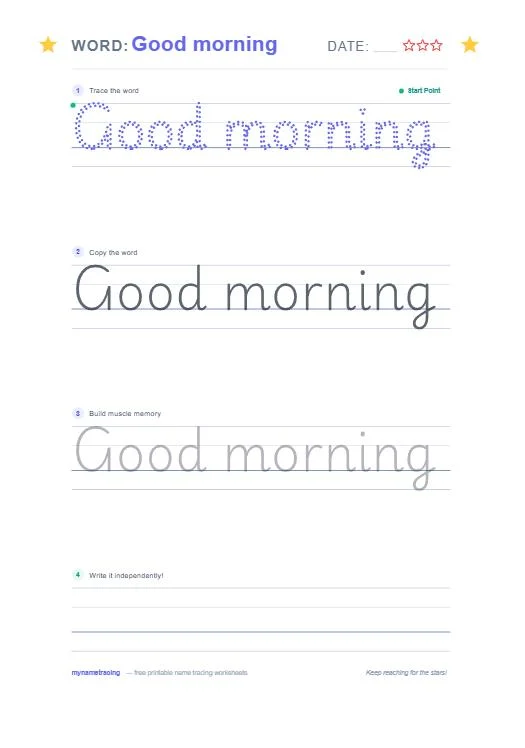
Trace single cursive letters, joins, words and names — or grab the whole connected alphabet as one PDF. Real school fonts on four-line guides. Free, no signup.
✓ No signup required · ✓ Vector PDF
Popular practice packs
Tap a pack to preview it full size, download it as-is, or customize it in the generator above — everything is generated live in your browser. No account, no email.
How it works
More ways to practice
What's inside every cursive practice worksheet
The same teaching structure on every page — whether you print one sheet or a whole pack.
How to teach cursive practice at home
Five focused minutes, four simple steps — the order matters more than the time spent.
Three cursive fonts, one practice flow
Pick the style your child's school uses — switching never means re-learning the page.
Cursive worksheet FAQ
When should children start cursive?
Most schools introduce it in grade 2–3, once print letters are automatic. If your child still reversals print letters, give it a little more time — cursive actually helps many children who struggle with print, because the letters flow in one continuous motion.
Which cursive font matches my school?
England J is an unlooped style taught in many UK schools, México is a slanted continuous style used across Latin America, and US Trad is the classic looped American hand. Ask your child's teacher, or pick the one that looks like your child's workbook.
Why don't the capital letters connect?
In most modern cursive styles, capital letters stand alone — only lowercase letters join. That is why the A–Z grid traces lowercase only.
My child's letters won't join up. Any tips?
Check the exit stroke: every lowercase letter must finish reaching up to the top line before the pen lifts — that upward tail is what the next letter starts from. Tracing slowly over the dotted guide, without lifting the pencil inside a word, builds the habit.
Why do the letters print smaller than on screen?
Your print dialog is scaling the page. Set the scale to Actual size / 100% — see the printing guide for the exact setting in every browser and PDF reader.
Is it really free?
Yes — no signup, no email, no watermark. Everything is generated in your browser and nothing you type is sent anywhere (see Privacy).
Is cursive practice still required in Australian schools?
Most Australian states expect students to move from unjoined to joined handwriting by year 3–4, though assessment is usually through legibility rather than a specific slant. The Edu AU VIC WA NT font used here mirrors the style taught across WA, VIC and NT classrooms, so practice at home matches what your child sees at school.
Can I do cursive practice with my child's own name?
Yes — type the name in the generator above and every sheet uses it. Names are actually the best cursive practice words: children already know the letters and the meaning, so all their attention goes to the joins. Accented names like Sofía or José work in every cursive font.
Should my child learn print first, or can they start with cursive practice?
Most curricula teach print first and introduce cursive around grade 2–3, and that ordering is the safest. That said, some European systems start with cursive from day one — if your child's school does, the letter grid and join packs are enough; there is no need to double up on print worksheets.
Which letters should cursive practice start with?
Start with the joins built from easy exit strokes: ul, il, im and un. They teach the two movements every join needs — finishing tall and finishing short — without demanding new letterforms. The First Joins pack below follows exactly that order.
Does cursive practice help with reading?
Yes, in two ways. Tracing connected letters forces attention to whole word shapes rather than isolated letters, which supports orthographic mapping — the skill behind fluent reading. And because cursive words are written in one motion, children tend to sound out the whole word as they write it, reinforcing the letter-sound links print worksheets often miss.
How is this different from the alphabet worksheets?
The alphabet worksheets teach print letterforms one at a time; this page teaches connected writing. The engine and four-line guides are identical, so children move between the two without relearning where letters sit — print for recognition, cursive practice for flow, both from the same generator.
Which pencil is best for cursive practice?
A normal HB pencil is perfect — cursive needs a pencil that can roll into the entry strokes without scratching, and HB does that at any budget. Avoid mechanical pencils for the first weeks: the hard, thin tip catches on the guides, and young hands press hard enough to snap the lead. Chunky triangular grips help four and five year olds hold the angle that cursive joins depend on.