
Number Worksheets
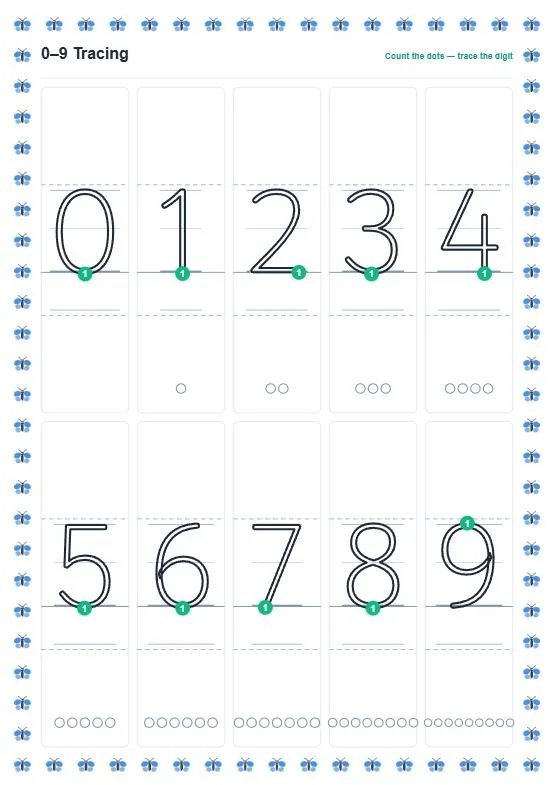
Pick a single digit for a focused practice page, or download 1–10 and 1–20 as one PDF. Counting dots, real school fonts on four-line guides — free, no signup.
Number
Handwriting font
Number style
Grade level
Paper size
Stickers
✓ No signup required · ✓ Vector PDF
Popular practice packs
Tap a pack to preview it full size, download it as-is, or customize it in the generator above — everything is generated live in your browser. No account, no email.
How it works
More ways to practice
What's inside every number worksheet
Counting and handwriting in one page — the same structure from 0 all the way to 100.
How to teach number tracing at home
Count first, write second — numerals stick when the amount comes before the symbol.
Number groups that make sense
The packs above climb one step at a time — count, write, then combine.
Number worksheet FAQ
When should my child start tracing numbers?
Most children are ready around age 4, once they can count to ten out loud. Counting comes before writing — the counting dots under each digit are there to say aloud first, then trace.
What are the dots under each number for?
Each digit has a row of count-and-color dots showing its value. Say the numbers aloud while ticking the dots off, then trace the digit. Zero has no dots — on purpose: zero means nothing.
My child writes numbers backwards. Is that normal?
Yes — reversing 2, 3, 5 and 7 is common up to age 6–7. Tracing the same digit repeatedly, with a clear numbered start point, is one of the best ways to settle direction.
Why do the numbers print smaller than on screen?
Your print dialog is scaling the page. Set the scale to Actual size / 100% — see the printing guide for the exact setting in every browser and PDF reader.
Can we reuse the same sheet?
Yes. Slip the printout into a clear plastic sleeve or laminate it and use a low-odor dry-erase marker — the dotted lines wipe clean and one sheet lasts the whole week.
Is it really free?
Yes — these free printable number worksheets cost nothing: no signup, no email, no watermark. Everything is generated in your browser and nothing you type is sent anywhere (see Privacy).
Should number tracing use numerals or number words?
Both, in that order. Numerals 0–9 are the writing priority for preschool and kindergarten; number words (one, two, three) suit kindergartners and first graders who already write letters. The number-words pack uses the same four-line guides, so the transition costs nothing.
What grade are these number worksheets for?
Pre-K through 1st grade. Pre-K prints very large digits with wide spacing, kindergarten matches standard workbook sizing, and 1st grade moves to smaller rows that leave room for two-digit numbers like 11–20.
Can I download 1–20 as a single PDF?
Yes — the teens pack covers 11–20, the count-and-trace packs cover 1–5 and 6–10, and the generator can build any range as one multi-page PDF. Everything downloads in a click, no signup.
Do the number worksheets include skip counting?
Yes — the tens pack counts 10, 20, 30 up to 100 with a butterfly sticker theme, and the skip-by-2s pack introduces early multiplication patterns. Both use the same tracing rows as the core number worksheets.
How does number tracing support early math?
Writing a numeral while saying its name links three systems at once — the symbol, the sound and the amount shown in the counting dots. That multi-sensory loop is what makes later math click: children who can form digits effortlessly spend their thinking on the counting, not on the pencil.
Should digits be the same height as letters?
Almost. Digits 0–9 sit between the middle and bottom lines like short letters, with no ascenders — that is exactly how the four-line guides on these number worksheets place them, so a traced 5 matches the height of a written a or o rather than a tall b.
How long should a number tracing session last?
Five focused minutes, three times a week beats a half hour on Sunday. A good stopping rule: one row traced carefully, one copied, one attempted alone — then stop even if there are blank rows left. Fresh pages are cheap; frustrated pencil grips are not.
Can I use these number worksheets in my classroom?
Yes — free printable number worksheets from this site may be printed for whole-class use, and the Batch panel turns a class list into one multi-page PDF with every student's name in the header. Morning warm-up for thirty kids takes about as long as one coffee.
Why does the generator use counting dots under each digit?
Because a numeral is an abstract symbol, and four year olds think in quantities. The dots under a traced 4 give the number a countable body — touch one dot for each count and the digit stops being a shape and becomes an amount. Once that link is automatic the dots quietly disappear from later packs.
What paper size should I print number worksheets on?
Whatever your printer holds — Letter for US and Canada, A4 almost everywhere else, and the generator lays the guides out natively for either. The one rule that matters is printing at Actual size rather than Fit to page: the 100 mm ruler at the bottom of every sheet tells you instantly whether the scale is honest.